Donating Breast Milk: Why It Matters & How to Do It
-
 By
Jacque Ordner - Motif Medical
By
Jacque Ordner - Motif Medical
- Apr 30, 2026
Why Does Donor Milk Matter?
Nearly 400,000 U.S. infants spend time in a NICU every year. Ninety percent of all U.S. hospitals rely on donated breastmilk for the most vulnerable infants inside their walls. Breastmilk is a valuable medical intervention for these tiny babies because it helps reduce the risk of NEC (necrotizing enterocolitis) by up to 70%. NEC is a life-threatening intestinal disease that mostly affects preterm and medically fragile infants. For these babies, human milk is a valuable lifeline.
The AAP (American Academy of Pediatrics), WHO (World Health Organization), and CDC (Centers for Disease Control) recommend human milk for all babies, even if milk from their own mothers is not available. Donor milk fills in the gaps for infants whose mothers are working to increase supply or who are unable to breastfeed. If an infant requires supplemental nutrition after birth, their mother’s own milk is the first choice, then donor breastmilk, then formula. While incredibly powerful, donor breastmilk is often in short supply in U.S. hospitals.1, 2, 3, 4
Have an Oversupply? Consider Donating!
Mothers who make more breastmilk than their infants will consume are excellent candidates to become breastmilk donors. Oversupply, or hyperlactation, occurs when milk production consistently and significantly exceeds your baby’s needs. This is typically quantified as breastmilk production greater than 35 ounces in 24 hours.
Symptoms of Oversupply
-
Persistent engorgement despite frequent feeding or pumping
-
Frequent, excessive leaking
-
Forceful letdown (Overactive Milk Ejection Reflex)
-
Recurrent clogged ducts (ductal narrowing) or mastitis
-
A freezer stash that is growing faster than it can be used
-
Infant symptoms: frequent pulling off of the breast, crying with feedings, gassiness, choking, gulping, green or frothy stools, abnormal weight gain
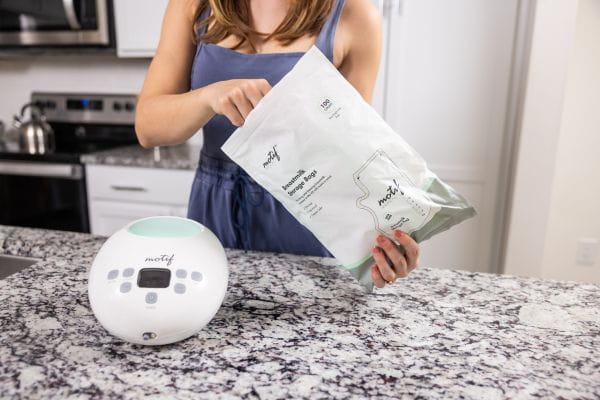
Dealing with oversupply can be uncomfortable and problematic for both mom and baby, but donating is a meaningful way to channel it.
How to Incorporate Pumping for Donation
Donation Requirements
Check with your milk bank regarding donation requirements. Many milk banks require 100 ounces to 200 ounces before pickup/shipment.
Adding Pumping Sessions for Donation
Ensure direct breastfeeding is going well before introducing extra pumping for the purpose of donating breastmilk. It’s best to talk with an IBCLC to make a plan before starting.
While it might work out well for you to incorporate some extra pumping during this time, you’ll want to avoid creating a “pump-demand cycle” where you need to pump between every nursing session just to avoid painful engorgement, clogged ducts (ductal narrowing), or mastitis.
-
Use caution and seek the personalized advice of an IBCLC if you desire to add extra pumping before six weeks postpartum.
Early morning pumping sessions often yield more milk due to the cyclic nature of prolactin production.
- Adding in a 10-minute pumping session after the first nursing session of the day is a great way to begin collecting extra milk.
Piggy-back pumping sessions are a manageable way to build a donation stash.
- Just like those early morning sessions, adding in occasional piggy-back 10-minute sessions after regular nursing or pumping sessions helps gently increase supply for the purpose of donating.
Breastmilk donation should never compromise your health and well-being or the health and well-being of your baby. 5
Safe Breastmilk Storage Guidelines
- Use a pump or hand express for 10-15 minutes on each breast several times a day. Ideally, at least eight times in 24 hours. Swapping sides every few minutes may be more effective than a longer session on one side.
- Expressing at least once at night will provide extra stimulation as this is when levels of milk-making hormones are highest. This also means that you don’t go for a long period without pumping. Remember frequency is key!
Clearly Label Your Milk
-
Include the month, day, and year.
-
Include the time
-
Include the amount
-
-
Weighing milk using a food scale is a more consistent and accurate way to determine the amount since bottles and milk storage bags can vary. One milliliter of breastmilk weighs ~ 1 gram. Thirty grams = ~ 1 ounce of breastmilk.
-
While it’s typically recommended to store milk in 2 oz and 3 oz portions for personal use, when donating, it’s ok to store the max volume of milk your breastmilk storage bag or container can safely hold for freezing.
-
-
Note any medications, including over-the-counter medications or supplements.
Other tools to help baby back to the breast are nursing supplementers, also known as a supplemental nursing system (SNS), which use a tiny tube taped to side of the nipple, and is slowly fed breastmilk or replacement to encourage suckling and stimulation at the breast. This helps with latching and milk supply stimulation.
Normal feeding frequencies can be overwhelming for any mom to wrap their head around. It’s quite normal to feel discouraged and overwhelmed when doing the same without having the gratification of milk expression. Setting healthy and achievable goals, adjusting expectations, and prioritizing mental health can be the very things that make or break your experience. Make sure to seek out help from a lactation professional and support groups.
Donating to a Formal Milk Banks & Informal Milk Sharing
What is a Formal Milk Bank?
A formal milk bank is one that is accredited and monitored. The Human Milk Bank Association or North America (HMBANA) is considered the gold standard for nonprofit milk bank accreditation in the United States. They help create and enforce national standards for pasteurized donor human milk donations.6
The Screening Process
-
Bloodwork (HIV, HTLV, Hepatitis B and C, and Syphilis)
-
Health history questionnaire to rule out any health conditions that would prevent donation
-
Prescreening call with the donation coordinator to make sure the donating mother is a good fit for the donation program
-
Smoking is not allowed. Strict limitations on alcohol consumption are enforced, and certain medications may exclude a mother from donating.
The Screening Process
-
Bloodwork (HIV, HTLV, Hepatitis B and C, and Syphilis)
-
Health history questionnaire to rule out any health conditions that would prevent donation
-
Prescreening call with the donation coordinator to make sure the donating mother is a good fit for the donation program
-
Smoking is not allowed. Strict limitations on alcohol consumption are enforced, and certain medications may exclude a mother from donating.
The Donation Process
Depending on your milk bank’s location and process, you may be asked to drop off your milk or ship it. Many milk banks provide free, sterile collection containers as well as shipping materials. Once milk is received at a donation center, it is pooled, pasteurized, and distributed. Pasteurization kills pathogens while preserving immunologic factors in breast milk.
Pros
-
Rigorous donation standards
-
Peace of mind for the donors and recipients
-
Milk is distributed to the most vulnerable babies.
Cons
-
Strict rules mean some donors are disqualified.
-
Enzymes, immune, and bioactive factors are decreased by the pasteurization process.
What is informal breastmilk donation?
Milk donated from one mother to another outside of an accredited milk bank is considered peer-to-peer or informal breastmilk donation. It may be facilitated between two individuals privately or with the help of organizations such as Eats on Feets or Human Milk 4 Human Babies.7, 8
Why do some families choose informal milk sharing?
There are fewer barriers for families looking to donate or receive breastmilk. There is no formal screening process for peer-to-peer milk sharing, so healthy donors who were rejected from formal milk donation programs can still share their precious liquid gold. Families also appreciate that there are typically no waitlists or high costs associated with informal milk sharing.
Pros
-
Much simpler process than formal milk donation
-
Typically less expensive
-
Many families prefer milk that hasn’t been pasteurized.
Cons
-
The FDA and AAP caution against informal milk sharing due to the lack of rigorous screening and pasteurization
-
Families may need to connect with several donors to obtain enough milk for their babies.
-
Meetups for milk pickup can require driving a significant distance for some families.
Meaningful Sacrifice
As an RN, IBCLC, and mom of four, I know how hard it can be to part with the milk you worked so hard to pump. This can be true even if you make significantly more milk than your baby can drink. If you’re an oversupplier considering breastmilk donation, just know that a single pumping session can yield enough milk to feed multiple tiny preterm and vulnerable infants. The precious gift of your milk can literally be life-changing for another family.
Sources:
- https://milkbankne.org/2025/09/nicu-by-the-numbers-9-surprising-things-to-know/
- https://publications.aap.org/pediatrics/article/150/1/e2022057988/188347/Policy-Statement-Breastfeeding-and-the-Use-of?autologincheck=redirected
- https://www.who.int/health-topics/breastfeeding#tab=tab_1
- https://www.cdc.gov/breastfeeding/php/guidelines-recommendations/index.html
- https://pmc.ncbi.nlm.nih.gov/articles/PMC10900018/#:~:text=Prolactin%20is%20controlled%20by%20the,cortisol%20%5B15%2C%2016%5D.
- https://www.hmbana.org/about-us/
- https://eatsonfeets.org/
- https://www.hm4hb.net/faq/
Information provided in blogs should not be used as a substitute for medical care or consultation.