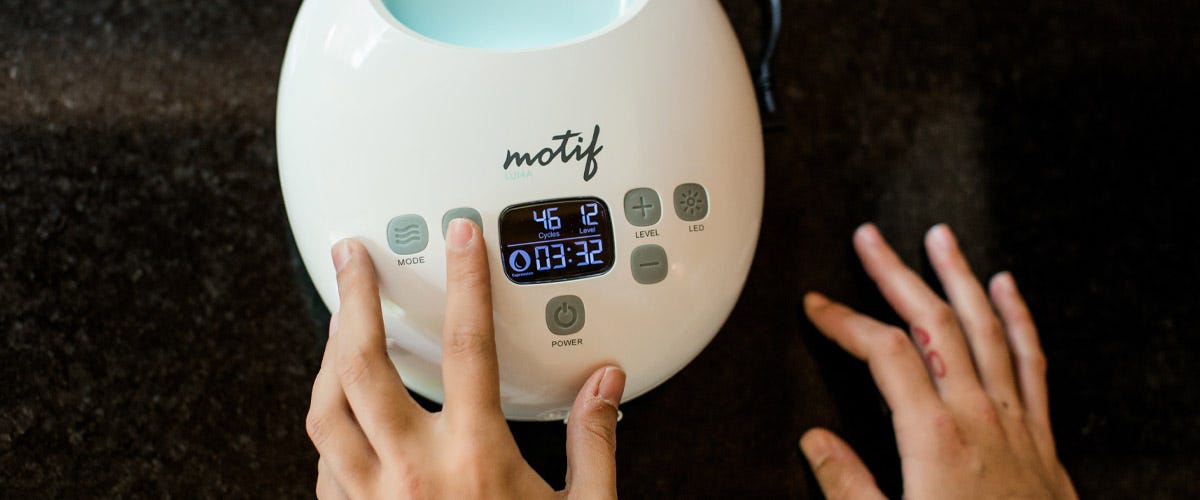
Breastfeeding & Pumping Schedule For New Moms
- Aug 14, 2026
Updated on 8/04/2026
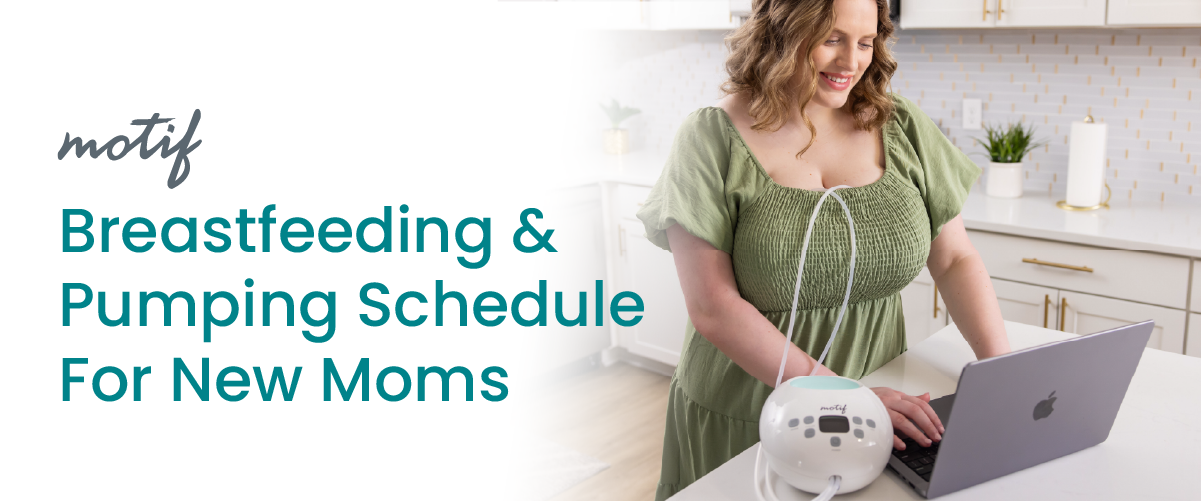
Having a baby comes with plenty of new tasks and adjustments, but moms may not need to start breast pumping immediately. Milk supply concerns often make moms think otherwise. Unfortunately, pumping output is not a reliable gauge of total milk supply, especially in the first days postpartum. Many new moms question if they're producing enough milk, which can lead to anxiety.
On the flip side, with pumps becoming more efficient than ever, if mom is breastfeeding AND pumping, it can result in an oversupply.! It's basically telling the body to create milk for more babies than there actually are. Milk supply is largely demand-driven.
Should a mom implement a pumping routine, and if so, when? While there isn’t a single answer to this, here are some things to consider.
When to Implement a Pumping Schedule
Generally, milk removal should occur every 2-3 hours, sometimes even more often than that. If direct breastfeeding is not an option for a period of time, it’s important to have a means to remove milk to prevent engorgement, clogged ducts (ductal narrowing), and even mastitis and to protect overall milk production.
This prevents the buildup of FIL (Feedback Inhibitor of Lactation), a protein that communicates the usage of milk or lack thereof. If milk is not removed frequently enough, the concentration of FIL increases, telling the breasts to slow milk production. Milk flow also keeps the ducts and nipples flushed of bacteria and helps prevent inflammation.
Situations That May Require A Pumping Schedule
Separation From Baby For 4+ Hours or More
The most common reason to start a pumping schedule is when you cannot be physically present to feed your baby. Whenever you miss a regular nursing session, removing milk with a pump is essential to prevent engorgement and protect your ongoing milk supply. You will likely need a pumping routine in situations such as:
-
NICU stay
-
Medical issues that may cause separation of mother and infant or temporarily prevent direct breastfeeding
-
Returning to work or a planned night out
Outside of separation, there are specific medical or lifestyle reasons to introduce a pump.
Low Breast Milk Supply
You may consider pumping to boost your breast milk supply. Pumps are an excellent tool for increasing stimulation and milk removal, but it is best to consult with an IBCLC (International Board Certified Lactation Consultant) to make a plan to address concerns about milk supply.
Even if milk removal or output does not occur when pumping is first introduced, repetition, an intentional schedule, and technique will encourage the body to take the hint and produce more milk.
Some common culprits behind low supply include:
-
Poor/inconsistent latching
-
Insufficient glandular tissue (IGT)
-
Separation from your baby
-
Hormonal imbalances
-
Heavy bleeding, severe hemorrhage
-
Retained placental fragments
-
Medication meant for drying up secretions (i.e., allergy and cold medications)
Personal Preference / Exclusive Pumping (EP)
Some mothers truly feel uncomfortable feeding directly at the breast, whether due to a history of abuse, lack of support, or other reasons for aversion. Other mothers simply find exclusively pumping more conducive to their lifestyle and preferences!
Obstacles encountered at the beginning of the breastfeeding relationship may lead to Exclusive Pumping (EP), which can work really well for the mother and baby(ies).
In general, exclusive pumpers will need to pump for 15-20 minutes every 2-3 hours. Once milk supply is well-established, it may be possible to decrease the number of pump sessions per day. It’s beneficial to seek guidance from an IBCLC on exclusive pumping to maintain long-term supply and reach breastfeeding goals.
When to Wait to Pump
Having a pump is a wonderful tool to keep on hand. Unforeseen obstacles happen quite often, and a good pump can really save a nursing relationship and a mother’s goals. However, using the pump right out of the gate is typically unnecessary.
It’s best to wait to pump if:
-
Breastfeeding is going well: It is not painful, the baby is gaining adequate weight, and there is no engorgement or mastitis.
-
You have time off: If you're planning to stay home or have at least 4-6 weeks off from work, you’ll have time to focus on nursing before introducing pumping.
Keep your preferred pump on hand, but do not feel pressured to incorporate it right away.
Choosing a Breast Pump
A great time to choose your pump is during pregnancy. Many insurance plans now cover breast pumps. Some things to consider when choosing a breast pump:
-
How often will you be using the pump? Occasionally? For work?
-
Flange size (nipple diameter in mm)
-
Is a battery option needed?
Need a recommendation? A top choice is the Motif Luna Breast Pump. It’s a compact, hospital-grade, closed-system breast pump with both plug-in and battery-powered models that are shown to provide More Milk in Less Time®. Plus, it is eligible for health insurance coverage!
Creating Your Breastfeeding & Pumping Schedule
Understanding Breastfeeding Schedules
-
NICU stay
-
Medical issues that may cause separation of mother and infant or temporarily prevent direct breastfeeding
-
Returning to work or a planned night out
Outside of separation, there are specific medical or lifestyle reasons to introduce a pump.
Low Breast Milk Supply
Fortunately, healthy babies who are feeding and gaining weight well can be trusted to take the lead on when to eat. Feeding “on demand” refers to this method. Active feeding, not counting time spent soothing or burping, occurs on average every 2-3 hours.
However, because babies use breastmilk not only for calories but also for immunological support and development, they may ask to feed more frequently or sporadically. By not keeping to a strict feeding routine, this need can be satisfied based on your baby’s cues.
- The Newborn Exception: For the first few days, breast milk is mostly colostrum, and they need even more frequent feedings at the breast. Newborns may also be sleepy and need help waking up to feed. Newborns should be fed at least 8-12 times in 24 hours.

-
The Cluster Feeding Exception: Cluster feeding occurs when a baby cues to feed more frequently than usual for a limited period. For example, a newborn may cue to eat every 40 minutes during the evenings for a 3-5 day stretch, then return to a more predictable feeding pattern. Cluster feeding is a normal part of breastfeeding.
-
When a strict schedule is necessary: In cases such as prematurity, jaundice, tongue-tie, and other issues that may contribute to complications with weight gain, implementing a schedule helps keep track of feedings. Ensuring that the baby does not exceed the typical time between feeds can dramatically improve outcomes and help avoid risks such as weight loss, low blood glucose, prolonged jaundice, and dehydration. For most newborns, this means not going more than 3 hours between feedings during the day and only allowing a single 3-4 hour stretch with no feedings at night, but in some cases, more frequent feedings may be necessary.
How to Tell if Your Baby is Getting Enough Milk
Check your baby's diapers to see if your baby is getting enough milk. After the first week, expect to find 6 wet diapers and 4 mustard-colored stools. This will stay consistent for about a month, then the number of stools during the day may decrease.
If your baby isn't getting enough milk, then they won't be gaining weight or won't be back to their birth weight after 14 days. Their stools may be less frequent, hard, dry, and not mustard-colored, and your baby may not be settled after nursing.
Your breasts may also signal that your baby isn't getting enough milk if you seem engorged after nursing or if your milk hasn't come in yet.
Understanding Pumping Schedules
Determining when to pump can feel overwhelming, but there is absolutely a method to the techniques and circumstances. First, determine the needs that pumping fulfills. Will it be occasional bottle-feeding, or something more consistent, like returning to work or pumping full-time?
Regardless of the frequency needed, one rule applies in all circumstances: For every missed or skipped opportunity at the breast, pumping or expression must occur to build or maintain milk supply.
This is particularly important to keep in mind for those with a partner or caregiver providing bottle feedings, such as at night, so the mother can rest. It does not help the breast supply if expression does not occur when appropriate. Even taking 5-10 minutes to pump in the middle of the night is better than going hours without pumping at all!
Pumping in the First Three Days
If milk expression is needed during the first three days, it is best to resist the pressure to hook up to a pump directly after birth. Instead, incorporate breast massage and hand expression techniques FIRST with each session, followed by pumping.
Mothers produce colostrum for the first 2-3 days postpartum, as the transition to greater milk production begins. Colostrum is thick and sticky and is produced in small volumes. This precious first milk can be difficult to express and collect with a pump, so it is best to use hand expression to remove colostrum. Pumping after hand expression likely won’t yield much output, but it will send the signal for your breasts to make more milk in the future.
"Frequent colostrum removal, coupled with breast and nipple stimulation, is key to building an abundant milk supply. Colostrum should be removed every 2-3 hours and can be fed directly to the baby." - Jacque Ordner
Things to keep in mind:
-
Newborn intake of colostrum grows from 5 ml to 15 ml per feeding on day one, up to 30 ml per feeding by day three. Overfeeding can cause stomach upset and spit-up.
-
Colostrum is very concentrated in calories, among other vital properties
-
Colostrum output can be improved when in the same room as the baby
-
Mature milk takes 3-5 days to “come in”
The First Two Weeks
If needing to pump or express within this timeframe, it’s best to mimic the cluster-feeding patterns that the newborn would signal to their mother. The first 3-5 days may still be colostrum and transitional milk, and may require both hand expression and pumping.
The small volume of this type of milk means more frequent attempts to remove it. This looks like every 2 hours during the day and every 3 hours at night.
Pumping Mature Milk
Once milk production has transitioned to mature milk (after two weeks), pumping every 2-3 hours during the day and every 3-4 hours at night is ideal. As babies age, they naturally begin to consolidate their sleep. This may result in longer stretches with no feedings at night. If your milk supply is well-established and your baby is gaining weight well, it is appropriate to follow their feeding patterns for overnight pumping.
Occasional Bottle Feeding
For mothers who breastfeed and only need the occasional bottle, pumping for 10 minutes after a morning nursing session tends to work best for many. This short pumping session can be introduced a few days before the bottle will be needed and takes advantage of higher prolactin levels that occur earlier in the day. Milk from multiple pumping sessions can be combined for a bottle feeding. It is also important to pump for any missed nursing sessions.
Quick tip: Introducing a bottle between 4-6 weeks of age is ideal if the baby will ever need one in the future. Waiting to introduce the bottle after six weeks can increase the chance of bottle refusal, and introducing a bottle too early may interfere with direct breastfeeding.
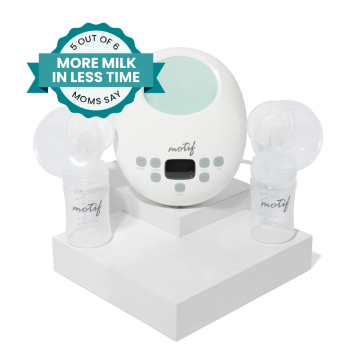
Luna Double Electric Breast Pump
Pumping for Building a Stash
If you're building a milk stash for work or extended separation during the day, begin with 1-2 pump sessions a day, 2 weeks before you need it. Mornings may work best, as there tends to be more volume to work with due to prolactin levels peaking in the early morning hours.
Things to keep in mind:
-
Mimic feeding times: Pumping sessions should be kept similar to average feeding times (i.e., double pumping for 15-20 minutes and at least every 2-3 hours).
-
Don't overdo it: A freezer-full of milk is NOT needed! The average amount needed when away from your baby is 1- 1.5 oz per hour. (e.g., 8-hour work day + 60-minute commute = 9 hours. 9-10 oz/day will do perfectly!)
-
Smell helps: Keep items that smell like your baby, like a onesie or blanket, near while you pump. This can help focus the body's response to the pump!
Pumping Schedules for Working Moms
If feeding from a bottle more frequently is needed, such as returning to work, or if the mother needs or desires to pump only, the pumping schedule needs to be structured and intentional to mimic the natural feeding patterns of a breastfed baby.
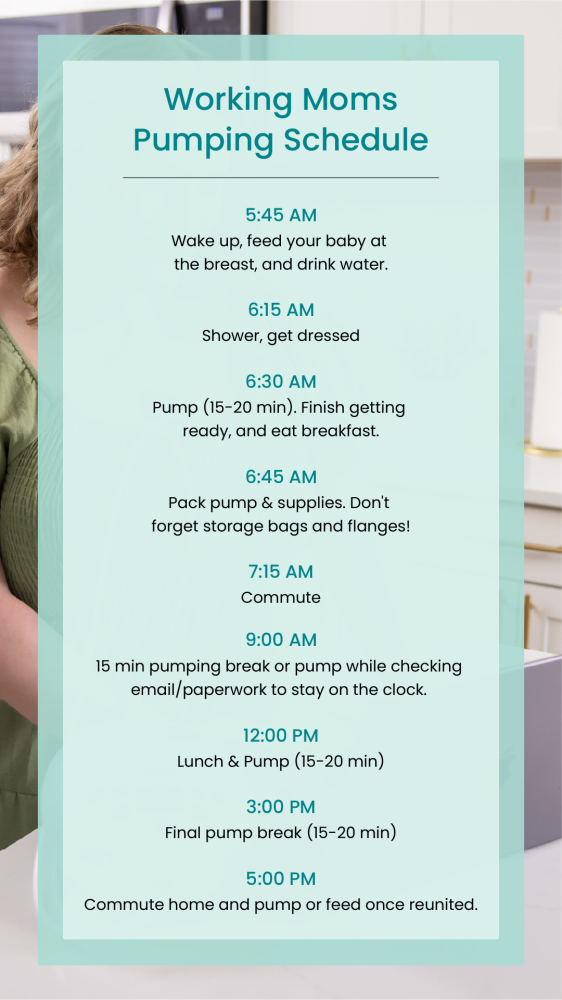
While this is a single example, a set workflow can make keeping up with pumping much easier and set an example of balance for employers and coworkers. Plus, it can be used as a much-needed mental break.
Tips for Pumping at Work
The FLSA Legal Rights
If you get nervous, remember that under the Fair Labor Standards Act (FLSA), employers with 50 or more employees must provide reasonable break time for mothers to express breast milk for up to a year after their child's birth. They must also provide a private space other than a bathroom for the purpose of breast pumping.
Talking to Daycare Providers
Start communications now with whoever will be caring for your little one. Discuss bottle-feeding a breastfed baby and expectations for the amount of milk to be given per feeding... Formula is typically given in larger amounts per feeding, and caregivers may unknowingly feed too much, which will put pressure on nursing mothers to keep up with an unnecessary stash. Ask about packing preferences: do they need ice packs or have access to a refrigerator?
In-Office Pumping Hacks
-
Bring a large food storage container that doubles as a handy wash basin and storage container for your pump parts. If you don’t have time to wash, consider pump cleaning sprays or wipes.
-
If you forget part of your breast pump or something breaks, don't panic. You can hand express breastmilk.
-
Wear button-down shirts or loose-fitting clothes to give yourself easy access to your breast.
-
Let emotions come. Missing your baby and lactating aren't easy. If you feel a wave of sadness coming, excuse yourself to your car or a private space until you're ready to return to work.
-
Create a checklist of everything you'll need to pack the night before. Packing the night before will help you prevent accidents... (I can recall forgetting storage bags or my flanges many times!)

Advanced Pumping Strategies & Tips
Power Pumping
It is not unusual to see a mild dip in milk supply during the first few weeks back at work. Power pumping is often recommended to help protect milk supply during the transition from maternity leave to work.
The most common power pumping format is to pump for 20 minutes, rest for 10 minutes, pump for 10 minutes, rest for 10 minutes, and pump for 10 minutes. Power pumping should be limited to 1-2 times per day for no more than 3-5 days. It’s best to work with an IBCLC to form a pumping plan that fits your specific situation.
The pre-programmed Cluster Feeding Mode, a feature of the Motif Roam and Motif Aura Glow breast pumps, is a mini power pumping mode that is safe to use as often as desired. This mode starts with 7 minutes of pumping, 5 minutes of rest, 7 minutes of pumping, 5 minutes of rest, and finishes with 6 minutes of pumping - all done automatically! Pausing and restarting stimulation help trigger an oxytocin spike. This oxytocin boost can lead to increased milk output.
Additional Tips
-
Check your fit: Take time to properly fit the breast flanges. This not only avoids pain and discomfort but also helps to pump more efficiently, saving time.
-
Get the right gear: Battery-operated pumps stay charged for many sessions, meaning fewer cords to deal with. Double-electric pumps let you express more milk in less time.
-
Storage: Milk storage bags travel nicely and can be kept cool with an ice pack until refrigeration is available. Breastmilk can be kept out at room temperature for up to 4 hours.
-
If you have more questions, the best option is always to see a lactation consultant!
Get Your Breast Pump Through Insurance
Establishing a successful routine takes patience, consistency, and the right equipment. A high-quality, hospital-grade breast pump can significantly improve your output and comfort, making it easier to stick to your schedule.
Fortunately, you likely do not need to pay out of pocket to get the best tools for you and your baby!
Most health insurance plans cover breast pumps at little to no cost. Motif Medical partners with leading medical suppliers to help moms access medical-grade breast pumps.
Check your eligibility to see if you qualify to receive a Motif breast pump through your insurance.
About The Author

Jacque Ordner is a mom of four sons and IBCLC in the heart of the Midwest in Illinois. Her love of lactation support began over a decade ago when she was working as a registered nurse. She specializes in adoptive lactation, breastfeeding after c-section, and pumping.
Information provided in blogs should not be used as a substitute for medical care or consultation.
Information provided in blogs should not be used as a substitute for medical care or consultation.